


Brain Benefits of Word Games
Updated: Jul 22
Imagine if someone told you there was an activity that could engage language, memory, attention, problem solving, visual processing, and decision-making simultaneously—all while feeling like entertainment rather than work.
That's exactly what happens every time you play a well-designed word game.
PART I - The Science Behind Word Games
For thousands of years, humans have enjoyed language puzzles. From ancient riddles and acrostics to newspaper crosswords and modern mobile games, word challenges have captivated people across cultures. Today, millions of players solve word puzzles every day—not only because they're enjoyable, but because they offer a rare combination of mental stimulation and relaxation.
In recent decades, neuroscientists have begun investigating what actually happens inside the brain during cognitively demanding activities like word games. Using technologies such as functional magnetic resonance imaging (fMRI), electroencephalography (EEG), and longitudinal cognitive studies, researchers have discovered that solving word puzzles activates an extensive network of brain regions rather than a single "language center."
Unlike passive activities such as watching television or scrolling social media, word games require active participation. Every puzzle demands that the brain retrieve information, evaluate possibilities, recognize patterns, inhibit incorrect answers, update working memory, and make strategic decisions. In other words, your brain is constantly exercising multiple cognitive systems at once.
While no game can guarantee protection against cognitive decline or increase IQ overnight, an increasing body of research suggests that mentally stimulating activities—including word puzzles—can contribute to maintaining cognitive performance, expanding vocabulary, improving attention, and building what neuroscientists call cognitive reserve.
This article explores what modern science tells us about the relationship between word games and brain health, why some puzzle mechanics challenge the brain more effectively than others, and how games like Reveal It! combine deduction, strategy, and language into a uniquely engaging mental workout.
Why the Human Brain Loves Word Games
Language is arguably humanity's most sophisticated cognitive achievement.
Every spoken or written word is the product of a remarkable chain of neural events. Within milliseconds, your brain must recognize visual symbols, identify letters, retrieve vocabulary from long-term memory, interpret meaning, compare possibilities, and select the most appropriate response.
Word games amplify this process. Instead of merely recognizing words, they require you to actively search for them. This distinction is incredibly important. Psychologists refer to this as the difference between recognition and retrieval.
Recognition is relatively easy:
"I've seen this word before."
Retrieval is considerably harder:
"I know this word exists... now I need to find it."
That retrieval process strengthens memory far more effectively than passive recognition.
This principle is known as the testing effect, one of the most consistently replicated findings in cognitive psychology. Research by Roediger and Karpicke (2006) demonstrated that actively retrieving information leads to significantly stronger long-term retention than simply rereading the same material.
Word games naturally exploit this phenomenon.
Every guessed word is essentially a miniature retrieval exercise.
Inside the Brain: What Happens During a Word Puzzle?
Although solving a word puzzle may appear simple on the surface, the brain coordinates an extraordinary number of processes simultaneously.
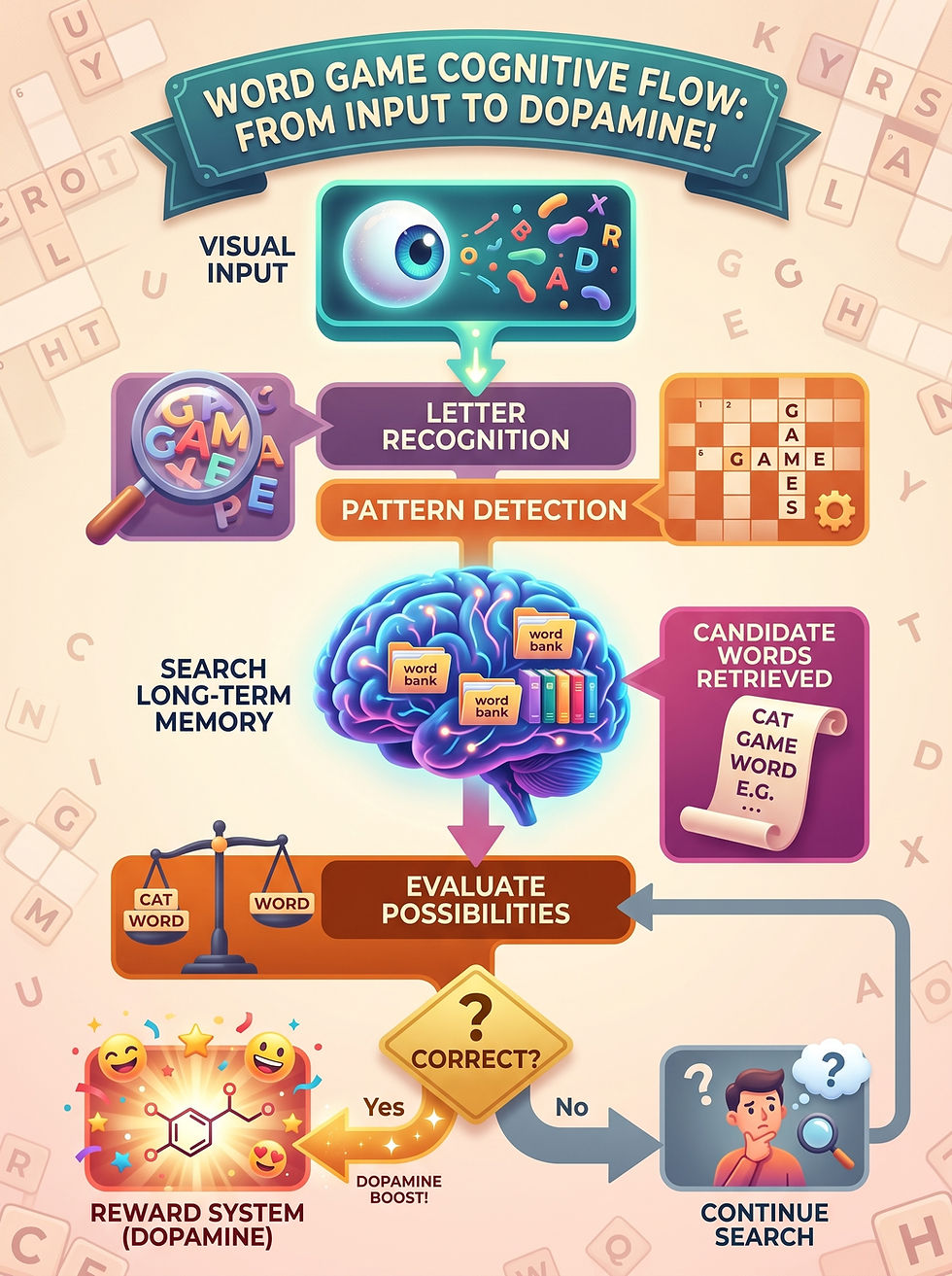
Each stage recruits different neural systems. Some specialize in language. Others handle attention. Others monitor mistakes. Others evaluate probabilities.
This distributed processing explains why word games can feel mentally tiring despite requiring no physical effort.
The Six Cognitive Systems Activated by Word Games
Modern neuroscience no longer views intelligence as a single ability. Instead, cognition is divided into interacting systems. Well-designed word games engage many of these simultaneously.

1. Language Processing
The most obvious system is language. When you encounter letters, your brain immediately begins matching them with stored vocabulary. Several regions become active, including:
Broca's area (language production)
Wernicke's area (language comprehension)
Angular gyrus (reading)
Temporal cortex (semantic memory)
These regions continuously compare letter combinations against tens of thousands of stored words.
Remarkably, this process occurs almost instantaneously.
2. Working Memory
Working memory acts as the brain's temporary whiteboard. Imagine trying to solve this puzzle:
A _ P L E
3. Better Vocabulary Through Active Recall
Unlike reading, word games require active engagement. They force your brain to retrieve words from memory.
Even before selecting another letter, your brain is already considering possibilities:
APPLE or
AMPLE.
Perhaps another uncommon word.
Keeping multiple candidates active simultaneously relies heavily on working memory. Unlike long-term memory, working memory has limited capacity. Every additional clue changes the possibilities. Players constantly update this temporary workspace while eliminating incorrect options. This continual updating is excellent mental exercise.
3. Executive Function
Executive functions are the brain's management system. They include:
planning
decision making
inhibition
cognitive flexibility
error monitoring
Suppose Reveal It! gives you only six incorrect guesses before losing. Choosing letters randomly becomes inefficient. Instead, experienced players begin thinking strategically.
Should I choose "E" because it's common?
Or should I test an unusual consonant?
Should I spend a hint now—or save it for later?
These decisions activate executive control networks primarily located in the prefrontal cortex.
4. Visual Processing
Even language begins with vision. Before words have meaning, they are simply patterns.
The occipital lobe first recognizes shapes. Only afterward do higher brain regions interpret those shapes as letters and words. Players become surprisingly good at spotting familiar structures:
T H _ _ _
Immediately suggests:
THERE,
THINK,
THROW, or
THREE
The brain specializes in pattern completion. and word games leverage this remarkable ability continuously.
5. Attention Networks
Attention is not a single process. Researchers divide it into multiple systems:
sustained attention
selective attention
divided attention
executive attention
Word puzzles particularly rely on sustained and executive attention. Distractions become costly. Every incorrect guess consumes valuable resources. As difficulty increases, players naturally narrow their focus.
This sustained concentration resembles what psychologist Mihaly Csikszentmihalyi described as flow—a state of deep immersion where attention becomes fully absorbed by the task.
6. The Reward System
Perhaps the most overlooked component is the reward system. Every solved puzzle generates satisfaction. This isn't merely emotional. It's neurochemical.
When players solve a difficult challenge, the brain releases dopamine—not because the puzzle itself is inherently valuable, but because solving uncertainty is rewarding. This creates a feedback loop:

Good game designers carefully balance challenge and success. If puzzles are too easy, boredom appears. If they're impossible, frustration dominates. The sweet spot lies between those extremes.
Recognition vs. Recall: Why Word Games Are More Powerful Than Reading Alone
Consider these two experiences.
Reading
You see the word:
ELEPHANT
Your brain instantly recognizes it.
Recognition is relatively effortless because the answer is already present.
You see the word: ELEPHANT
Your brain instantly recognizes it.
Recognition is relatively effortless because the answer is already present.
Solving a Puzzle
Now compare this with:
E _ E _ H A N T
Suddenly your brain must search. It
retrieves candidates.,
eliminates alternatives,
checks spelling, and
verifies confidence.
This active search process recruits much larger cognitive networks. Educational psychologists call this active recall, and it consistently outperforms passive review for long-term learning.
The implication is simple: Word games don't merely expose players to language. They require them to reconstruct language from memory. That distinction is crucial.

Cognitive Load: Why Good Word Games Feel Challenging
Not every puzzle exercises the brain equally. Researchers often describe mental difficulty using cognitive load — the amount of working memory and processing required to complete a task.
An effective word game gradually increases cognitive load by introducing uncertainty without overwhelming the player.
For example:
Easy Puzzle:
C _ T
Minimal processing required with very few options available.
Medium Puzzle:
C _ A _ E
Several possibilities compete.
Hard Puzzle:
_ R _ G _ I _ _
Now memory, vocabulary, deduction, and strategy all interact, because it is not easy to recognize immediate options, and even some options are recognized then the uncertainty of having many more matching options is on the table. Now, the brain needs more aids to come into a definitive conclusion.
The word games do trigger multiple functions by creating controlled ambiguity. And Reveal It! adds another layer of challenge by attaching consequences to incorrect guesses. Every wrong letter costs a token, forcing players to weigh probability against risk rather than simply trying every possibility. That subtle design choice transforms each puzzle from a vocabulary test into a decision-making exercise.
This combination of language retrieval and strategic resource management is one of the reasons modern mobile word games can provide a richer cognitive challenge than traditional paper puzzles.
PART II — Neuroplasticity, Attention, Dopamine, and Lifelong Cognitive Health
The Brain Is Designed to Change
For much of the twentieth century, scientists believed that the adult brain was largely fixed. Once we reached adulthood, it was thought that our neural wiring remained mostly unchanged, gradually declining with age.
Modern neuroscience has completely overturned that assumption.
Today, we know that the brain is remarkably adaptable throughout life. This ability to reorganize itself by creating, strengthening, and pruning neural connections is known as neuroplasticity. Every time we learn a new skill, practice a language, solve a difficult puzzle, or even navigate an unfamiliar route home, our brain modifies its own circuitry.
Word games provide an ideal environment for this process because they repeatedly challenge several cognitive systems at once. Unlike rote repetition, every puzzle introduces new combinations of letters, patterns, and decisions. Your brain can't rely on memorization alone — it must adapt.
Think of neuroplasticity like a network of hiking trails through a forest. The first time you walk a path, it's slow and difficult. Walk it every day, and the trail becomes wider, smoother, and easier to follow. Neural pathways behave similarly: frequently used connections become faster and more efficient, while unused ones gradually weaken.
From Letters to Meaning: Building Stronger Neural Networks
When you encounter a partially completed word, your brain doesn't search a mental dictionary alphabetically. Instead, it activates a network of related concepts simultaneously.
Consider the following puzzle:
C R O _ _
Even before identifying the first blank letter, your brain may activate words such as:
crowd,
crown,
cross,
crock,
crocs,
croft,
crops,
crone,
and more.. These candidates compete until additional information eliminates the incorrect ones.
Rather than storing words like files in folders, the brain organizes language as a vast interconnected semantic network. Words that are similar in spelling, pronunciation, or meaning are linked together. Every time you retrieve one of these words during a puzzle, those connections are reinforced.
This repeated activation is one reason regular puzzle solving may contribute to stronger vocabulary retrieval over time.
The Incredible Flexibility of Working Memory
Working memory is often described as the brain's "mental workspace." It's where
information is temporarily stored while you think, reason, and make decisions.
Imagine trying to solve this Reveal It! puzzle:
_ R A _ _ N
Several possibilities may immediately come to mind:
Dragon,
Crayon,
Brazen, and
others depending on the clues. Your brain now performs multiple operations simultaneously:
holding candidate words in memory,
comparing each against revealed letters,
rejecting impossible combinations,
updating possibilities after each guess,
remembering which letters you've already tried,
managing your remaining tokens.
Unlike long-term memory, which has enormous capacity, working memory is limited. Research suggests that most people can actively manipulate only a small number of pieces of information at once. Well-designed word games continuously stretch this capacity without overwhelming it, creating an ideal environment for cognitive engagement.
Attention: One of the Brain's Most Valuable Resources
In today's digital world, attention has become increasingly fragmented. Notifications interrupt conversations. Social media encourages rapid switching between topics.
Multitasking has become the norm. Yet the human brain was never optimized for constant task switching.
In reality, every switch carries a small cognitive cost. Word games offer a refreshing contrast. As puzzles become more challenging, players naturally narrow their focus. External distractions fade into the background because the brain becomes fully engaged in solving a meaningful problem.
Psychologists distinguish between several forms of attention:
Sustained Attention
Maintaining focus over an extended period.
This allows players to continue working through increasingly difficult puzzles without losing concentration.
Selective Attention
Filtering irrelevant information while focusing on what matters.
When dozens of possible words exist, the brain learns to prioritize the most likely candidates.
Executive Attention
Resolving conflicts between competing possibilities.
Should the missing letter be B or P? Should you spend a hint now or save it? Executive attention helps make these decisions efficiently.
Why Flow Makes Word Games Feel Effortless
Have you ever looked up after solving several puzzles and realized that thirty minutes had passed without noticing?
This phenomenon is known as flow, a psychological state first described by Mihaly Csikszentmihalyi.
Flow occurs when three conditions align:
the challenge is meaningful,
the player possesses enough skill to succeed,
feedback is immediate.
Word games satisfy all three remarkably well. Each puzzle presents a clear objective. Every letter selection provides immediate feedback. Difficulty gradually increases as players improve. During flow, people often report:
losing track of time,
reduced awareness of distractions,
increased enjoyment,
greater motivation to continue.
Designing games that consistently produce flow is one of the defining goals of modern game design.
Dopamine: The Brain's Motivation Chemical
Dopamine is frequently misunderstood as the "pleasure molecule." In reality, dopamine is better described as a motivation and learning signal. Rather than rewarding success itself, dopamine helps the brain learn which behaviors are worth repeating.
Consider what happens while solving a puzzle.
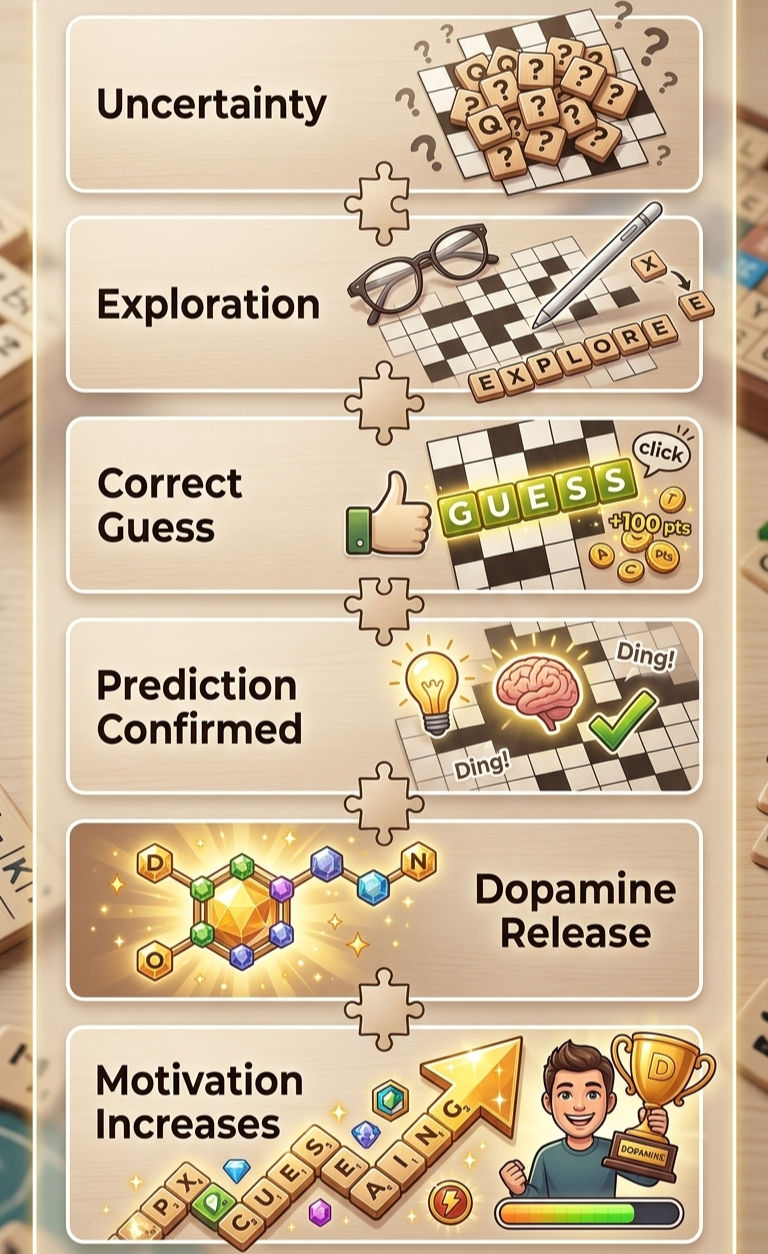
Notice that uncertainty comes first. If every puzzle were trivial, dopamine responses would quickly diminish because there would be nothing new to learn.
Conversely, if every puzzle were impossible, repeated failure would reduce motivation.
Great puzzle games carefully balance challenge and success. They create just enough uncertainty to keep players engaged while ensuring that progress feels achievable.
Reveal It! adds another layer to this balance through its limited-token system. Every incorrect guess carries a cost, encouraging thoughtful decision-making rather than random experimentation. This tension heightens the satisfaction of successful solutions.
Why Difficulty Curves Matter
One of the defining characteristics of an effective cognitive game is its difficulty curve. A poor difficulty curve creates either boredom or frustration. An effective one keeps players in their optimal learning zone.
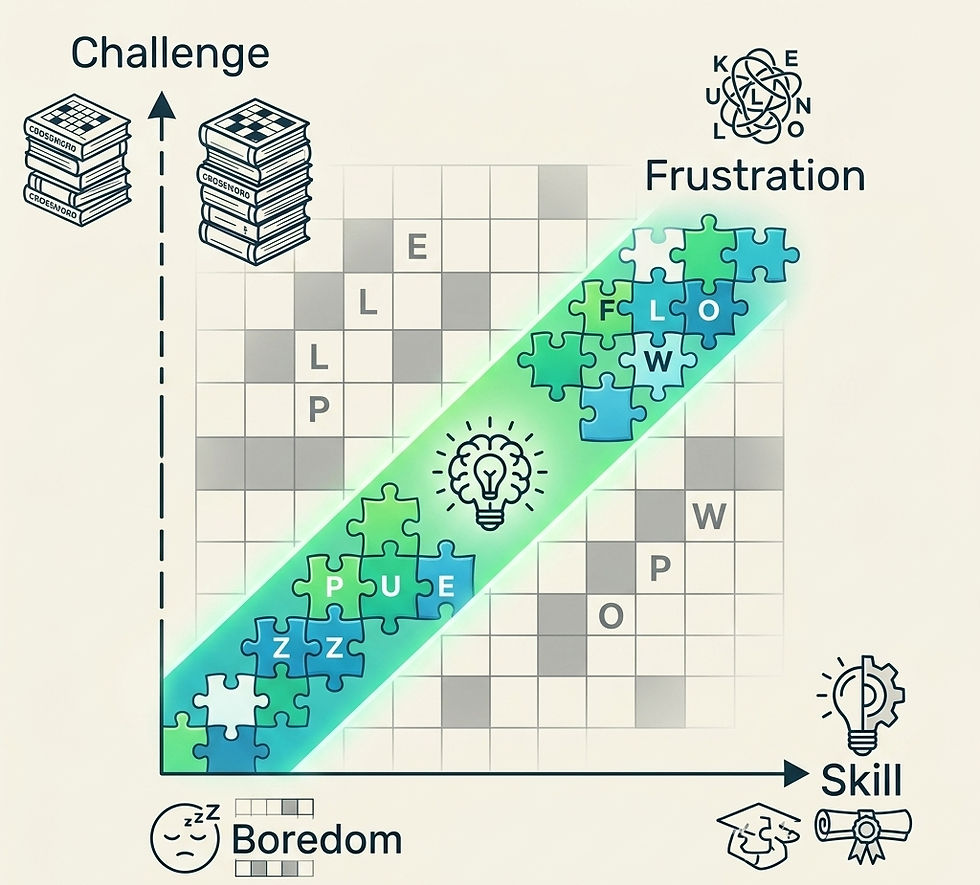
At the beginning of a game, puzzles should teach mechanics rather than test mastery.
As players improve, the game gradually introduces:
less common vocabulary,
misleading patterns,
strategic decisions,
increased uncertainty.
Yet, in a word game "difficulty" is not clear as black and white. Longer words doesn't mean harder puzzles to solve or vice versa. Uncommon vocabulary can be easy for someone who is engaged in an activity that requires frequent use of that word. For example, the phrase "umbilical cord" can be challenging for many people but it may certainly be the easiest phrase to solve for prospective mothers, gynecologists and few other group of people who frequently use that word.
Therefore, we had to re-think our level designing process while we develop Reveal It!. So, instead of trying to make each level gradually harder, we tried to make each level gradually less easy. And what makes a word puzzle easy? The hints, the signals you provide to the player! Our easy-to-hard level cycles provides more "free" clues to the player at the beginning of each cycle, and less "free" clues at the end of that cycle.
Vocabulary Growth Through Context
One of the unique strengths of word games is that they encourage vocabulary development through contextual reasoning rather than memorization.
Imagine encountering this puzzle:
_ N T E _ L I G E N C E
Even if you've never consciously studied the word intelligence, surrounding letters help narrow the possibilities.
Repeated exposure to words in meaningful contexts strengthens semantic memory far more effectively than isolated word lists.
Educational research consistently shows that contextual learning produces better retention because learners connect new information to existing knowledge.
Word games naturally exploit this principle.
Every solved puzzle becomes another meaningful encounter with language.
Pattern Recognition: The Hidden Superpower
Experienced word-game players often describe a curious sensation. They stop "reading" individual letters and begin seeing entire structures.
For example:
TH____
Immediately activates possibilities like:
Thought
Through
Thrive
Threat
Thread
This happens because the brain gradually becomes better at recognizing statistical regularities within language.
Pattern recognition extends far beyond word games.
It influences:
reading speed,
spelling accuracy,
language learning,
problem solving,
even creativity
Creativity itself often depends on recognizing unexpected connections between previously unrelated ideas.
Word Games and Cognitive Reserve
Perhaps one of the most intriguing concepts in neuroscience is cognitive reserve. Researchers have observed that some individuals maintain excellent cognitive function despite age-related changes or even significant brain pathology. One explanation is that years of education, intellectually stimulating work, social engagement, and mentally challenging leisure activities help build a reserve of flexible neural networks.
Think of cognitive reserve as having multiple routes to the same destination. If one pathway becomes less efficient over time, the brain can often rely on alternative networks.
Mentally stimulating activities — including reading, learning new skills, playing musical instruments, and solving puzzles — are all associated with higher cognitive reserve in observational studies.
It's important to be precise here: word games have not been proven to prevent Alzheimer's disease or dementia. However, there is growing evidence that regularly engaging in cognitively demanding activities is associated with better cognitive performance and may help people maintain their abilities as they age.
For this reason, many neurologists encourage a combination of:
lifelong learning,
physical exercise,
healthy sleep,
social interaction,
and mentally engaging hobbies such as puzzles and word games.
No single activity is a magic solution, but together they create a lifestyle that supports long-term brain health.
PART III — From Science to Everyday Play
Word Games vs. Other Brain Activities
One of the most common questions people ask is:
"Are word games actually better than other brain exercises?"
The honest answer is no single activity trains every aspect of cognition.
Different activities challenge different neural systems. The brain is more like a team of specialists than a single muscle. A violinist, chess player, marathon runner, and crossword enthusiast all develop different cognitive strengths.
Instead of asking which game is best, neuroscientists increasingly ask:
Which cognitive systems does this activity engage?
Let's compare:
Word Games
Primary Cognitive Skills
Vocabulary retrieval
Semantic memory
Pattern recognition
Working memory
Executive attention
Language processing
Excellent for:
language learners
readers
lifelong learners
older adults
anyone wanting daily cognitive stimulation
Sudoku
Sudoku contains no language. Instead it primarily develops:
logical reasoning
planning
working memory
inhibition
visual scanning
It is essentially mathematics without arithmetic. The cognitive demands differ substantially from word games.
Chess
Chess recruits perhaps the largest number of executive functions.
Players constantly evaluate
probabilities
future consequences
opponent intentions
spatial relationships
Chess develops:
planning
long-term strategy
cognitive flexibility
decision making
However, chess places much less emphasis on language.
Reading
Reading is incredibly valuable. It expands:
vocabulary
knowledge
empathy
imagination
Yet reading is largely recognition-based. The words already exist on the page. Word games require active retrieval. Both activities complement one another beautifully.
Match-3 Games
Match-3 games (such as Candy Crush or Rubi Blast) primarily train:
visual attention
planning
spatial reasoning
rapid decision making
reward prediction
Unlike word games, they involve relatively little semantic memory. However, well-designed puzzle games can still produce meaningful cognitive engagement through strategy and pattern recognition.
Video Games
Modern video games vary enormously. Some primarily train reaction speed. Others emphasize navigation. Others demand teamwork. Others resemble complex simulations. The phrase "video games" is therefore too broad to evaluate scientifically. What matters is what players are actually doing.
A Simple Way to Think About It
Imagine cognition as a fitness center. Cardio exercises your heart. Strength training develops muscles. Yoga improves flexibility. Likewise:
Word games train language.
Chess trains planning.
Sudoku trains logic.
Reading expands knowledge.
No single activity replaces the others. The healthiest cognitive lifestyle combines several.
Why Reveal It! Exercises More Than Vocabulary
At first glance, Reveal It! appears to be another word game. Underneath its elegant simplicity lies a surprisingly rich cognitive challenge.
Unlike traditional crosswords, players aren't simply recalling words. They're constantly balancing probability, uncertainty, and limited resources. Every move answers several questions simultaneously:
Which letter is statistically most likely?
How many tokens can I afford to lose?
Should I reveal another clue?
Is there enough evidence to commit?
This transforms vocabulary into strategic reasoning.
Layer 1 — Pattern Recognition
Suppose you see:
_ A _ E
Your brain immediately activates possibilities.
CARE
GAME
SAFE
WAVE
MAZE
Pattern recognition begins almost instantly.
Layer 2 — Probability
Now imagine you must choose one letter.
Do you select
R,
F,
G, or
V?
Each carries a different probability.
Players unconsciously perform Bayesian reasoning—updating the likelihood of possible words as new evidence appears—even if they've never heard the term "Bayesian."
Layer 3 — Risk Management
Reveal It! introduces limited guesses.
Suddenly every decision has consequences.
This activates executive functions that ordinary word searches rarely require.
Psychologists often describe this as decision making under uncertainty.
The same cognitive process is involved in:
financial decisions
medical diagnoses
scientific reasoning
strategic planning
Obviously, a mobile game isn't teaching finance. But it does exercise the underlying mental process.
Layer 4 — Adaptive Learning
Each failed guess becomes information. Players continuously update their internal model. This resembles reinforcement learning.

Learning isn't simply about getting answers right. It's about updating beliefs after mistakes. Great games encourage exactly this behavior.
The Importance of Failure
Interestingly, neuroscience tells us something surprising. Mistakes matter. When the brain predicts one outcome but experiences another, it generates what's called a prediction error.
Prediction errors are incredibly important. They're one of the primary drivers of learning. If players never make mistakes... ...their brains receive very little new information.
Likewise, constant failure becomes discouraging. The optimal learning environment lies somewhere in between.
Good games intentionally create manageable mistakes. Reveal It!'s limited-token mechanic naturally supports this balance. Players fail occasionally. But every failure teaches something.
Can Word Games Prevent Dementia?
This question appears in almost every discussion about cognitive training.
It's also one of the most misunderstood.
The short answer is:
No study has demonstrated that playing word games alone prevents Alzheimer's disease or dementia.
However —
That's not the whole story.
Large observational studies consistently find that people who remain mentally active throughout life tend to perform better on cognitive tests as they age.
Activities associated with healthier cognitive aging include:
reading,
lifelong education,
puzzles,
learning languages,
musical instruments,
social interaction, and
regular physical exercise.
Researchers believe these experiences contribute to cognitive reserve, allowing the brain to compensate more effectively for age-related changes.
Word games should therefore be viewed as one component of a brain-healthy lifestyle, not a miracle intervention.
Building the Ideal Brain Workout
Just as physical fitness benefits from variety, so does cognitive fitness.
A balanced weekly routine might include:
Activity | Frequency |
Word games | Daily (10–20 min) |
Reading | Daily |
Physical exercise | 150 min/week |
Learning something new | Weekly |
Social interaction | Daily |
Quality sleep | Every night |
Notice that no single activity dominates the list. Healthy brains thrive on diversity.
Myths About Brain Training
Myth 1
"I'll become smarter if I play enough word games."
Reality:
Word games improve specific skills like vocabulary, retrieval speed, attention, and strategic thinking. They don't magically increase every aspect of intelligence.
Myth 2
"Only older adults benefit."
Reality:
Children develop literacy. Students improve vocabulary. Professionals sharpen concentration. Older adults maintain cognitive engagement. Benefits exist across the lifespan.
Myth 3
"Five hours of puzzles every weekend is enough."
Reality:
Research consistently favors regular practice over occasional marathon sessions. Ten to twenty minutes every day is likely more beneficial than three hours once a week.
Myth 4
"Digital games aren't as good as paper puzzles."
Current evidence suggests that the cognitive demands of the task matter more than the medium.
A thoughtfully designed digital puzzle can engage many of the same cognitive systems as a printed crossword.
Practical Tips for Getting More From Word Games
If your goal is brain health rather than simply passing time, consider these habits:
Challenge yourself
Don't replay only easy puzzles.
Growth occurs when the brain encounters manageable difficulty.
Avoid guessing randomly
Strategic thinking activates executive functions.
Take time to evaluate possibilities before selecting a letter.
Learn unfamiliar words
Unknown vocabulary is an opportunity rather than an obstacle.
Curiosity strengthens memory.
Play consistently
Fifteen minutes every day is more valuable than several hours once a month.
Combine activities
Word games work best alongside:
reading
physical exercise
healthy sleep
meaningful social interaction
Final Thoughts
Perhaps the greatest strength of word games is that they blur the line between entertainment and learning.
Unlike formal study, they invite curiosity. Unlike passive entertainment, they demand participation.
Every solved puzzle is a conversation between your brain and uncertainty. Every incorrect guess refines your internal model. Every newly discovered word strengthens connections that may serve you in countless future situations.
Modern neuroscience increasingly supports what puzzle enthusiasts have believed for generations:
Keeping the mind active matters.
Word games won't make someone a genius overnight.
They won't cure neurological disease.
They won't replace education, exercise, or healthy living.
But they can become a remarkably enjoyable habit that exercises language, attention, memory, reasoning, and problem-solving—all within a few minutes each day.
Whether you enjoy traditional crosswords, anagrams, or modern games like Reveal It!, every puzzle offers an opportunity to practice one of the brain's greatest abilities:
The ability to learn.
Frequently Asked Questions
Are word games actually good for your brain?
Yes. Research suggests they engage multiple cognitive systems including language processing, working memory, attention, and executive function. While they are not a cure or guaranteed preventive measure for cognitive disorders, they are a mentally stimulating activity that can contribute to lifelong cognitive engagement.
Can word games improve memory?
They can improve working memory and strengthen retrieval practice by requiring players to actively recall words rather than simply recognize them.
Do word games increase IQ?
Current scientific evidence does not support the idea that word games broadly increase IQ. They improve specific cognitive abilities, but these improvements do not necessarily transfer to all measures of intelligence.
How long should I play each day?
Research generally supports consistency over duration. Around 10–20 minutes of focused play each day is a practical target.
Are digital word games as effective as printed puzzles?
The available evidence suggests that the cognitive challenge itself matters more than whether the puzzle is played on paper or on a screen.
Are word games good for children?
Yes. They can support vocabulary growth, spelling, reading fluency, and pattern recognition, particularly when the difficulty is appropriate for the child's age.
Are word games good for older adults?
Many older adults enjoy word games as part of an intellectually active lifestyle. Regular cognitive engagement is associated with better cognitive performance in aging, although no single activity has been proven to prevent dementia.
References
Bialystok, E., Craik, F. I. M., & Luk, G. (2012). Bilingualism: Consequences for mind and brain. Trends in Cognitive Sciences, 16(4), 240–250.
Csikszentmihalyi, M. (1990). Flow: The Psychology of Optimal Experience. Harper & Row.
Erickson, K. I., et al. (2011). Exercise training increases size of hippocampus and improves memory. PNAS, 108(7), 3017–3022.
Lampit, A., Hallock, H., & Valenzuela, M. (2014). Computerized cognitive training in healthy older adults. PLoS Medicine, 11(11), e1001756.
Park, D. C., et al. (2014). The impact of sustained engagement on cognitive function in older adults. Psychological Science, 25(1), 103–112.
Roediger, H. L., & Karpicke, J. D. (2006). Test-enhanced learning. Psychological Science, 17(3), 249–255.
Stern, Y. (2009). Cognitive reserve. Neuropsychologia, 47(10), 2015–2028.
Verghese, J., et al. (2003). Leisure activities and the risk of dementia in the elderly. New England Journal of Medicine, 348(25), 2508–2516.

